
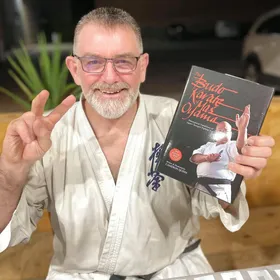
With over fifty five years of experience in Kyokushin Karate, he has dedicated much of his life to the pursuit, teaching, and evolution of martial arts. His journey began in 1971 as a 12 year old. In January 1976 at just 17 years old, he traveled to Japan to study Japanese and train under the legendary Mas Oyama. That same year, he took on his first role as an interpreter for Sosai Oyama at the 8th All Japan Championships, marking the beginning of a long-standing involvement at the highest levels of Kyokushin.
He continued to serve as Mas Oyama’s interpreter for many years, gaining rare insight into the inner workings and global expansion of Kyokushin while building relationships with many of its leading figures.
While his tournament career included notable achievements—such as winning two Australian titles and representing Australia at the 4th World Karate Championships in 1987—his true passion has always been in developing fighters. Over the years, he has trained and guided numerous high-level competitors, including Garry O’Neill, Walter Schnaubelt, Dominic Hopkins, and Yusuke Fujii. His influence has also extended into other combat sports, helping develop champion kickboxers and boxers such as Bain Stewart and Tyrone Tongia.
In 1988, he founded Australia’s first Kyokushin Uchi Deshi program, creating a pathway for serious students to immerse themselves in traditional, full-time training.
He is also the author of “The Budo Karate of Mas Oyama,” first published in 1987 with forewords by Sosai Mas Oyama and Shihan Bobby Lowe. Its enduring message—“A black belt is a white belt who never gave up”—has inspired martial artists for generations. A second edition was released in 2021, featuring a foreword by Dolph Lundgren.
Beyond Kyokushin, his martial arts journey has included extensive training with some of the world’s most respected fighters and grapplers, including Rico Chiapparelli, Randy Couture, Dan Henderson, Frank Trigg, Gene LeBell, and Erik Paulson. He has also devoted decades to Brazilian Jiu-Jitsu, earning a black belt under Gracie Barra and Carlos Gracie Jr., after beginning his training in 1994 with Carlos and Rigan Machado.
He appreciates Brazilian Jiu-Jitsu for allowing intense training with reduced risk of impact injury, making it a valuable complement to full-contact karate. In 1995, he introduced the term “Osu” into BJJ circles—a term that has since become widely adopted across the community.
Today, he continues to train regularly in both Kyokushin Karate and Brazilian Jiu-Jitsu. To him, they are not separate disciplines, but different expressions of the same martial path.