
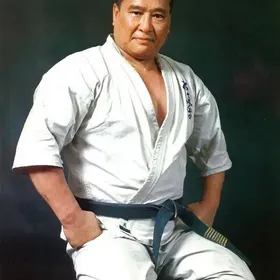
From early childhood, he studied kenpō (Chinese martial arts), and at age 13, he enrolled in the Yamanashi Youth Aviation School. In March 1938, he first learned karate from Gichin Funakoshi, the founder of Shotokan Karate.
He studied at Takushoku University and Waseda University, and in 1947 he won the All Japan Karate Championship.
He underwent intense training and discipline in seclusion at Mount Minobu and Mount Kiyosumi, mastering extraordinary techniques such as killing a bull with a single blow of his fist and cutting beer bottles. Eventually, he even defeated fierce bulls and came to be known as the “God Hand.”
In 1952, he travelled to the United States, toured the country and engaged in serious matches with professional wrestlers and others, achieving consecutive victories. At the same time, he introduced karate to the public. He continued traveling around the world, fighting practitioners of various martial arts and spreading the reputation of “karate” globally.
With the belief that “karate is the strongest,” he advocated full-contact karate. In May 1954, he established the Oyama Dojo, and in 1964 it was renamed the International Karate Organization Kyokushin Kaikan, where he assumed the position of Director.
He organized the All Japan Karate Championships and the World Karate Championships, sparking a Kyokushin boom and paving the way for today’s martial arts boom. (He influenced most Japanese combat sports such as K-1 and kickboxing, and many of their instructors have Kyokushin backgrounds.)
During this time, he established a global organization spanning 130 countries with 12 million practitioners, as well as over 50 branches in Japan with 500,000 members, building the largest martial arts organization and solidifying the reputation of “Kyokushin as the strongest.”
On April 26, 1994, he passed away, deeply mourned by many. However, the spirit of Kyokushin that he devoted his life to creating continues to be carried on by countless students around the world today.